

Quantum world
Quantum-Entangled Telenovelas
Our fantasies reflect our desires and often run ahead of reality. Almost everyone has, at some point, wished for access to the legendary transporter from Star Trek or the magical portkeys from the Harry Potter books. But what does reality actually allow?
We all know that quantum teleportation is nothing like science fiction. When, as a student, I first worked through the calculations of quantum teleportation, I found it curious that a derivation spanning just a few lines had as many as six co-authors. Coincidentally, the crew of the Star Trek spacecraft consists of seven characters, and the original transporter was designed for six. At Barcelona airport, the story of quantum teleportation was told to me by one of the paper’s authors, William Wootters.
The Tele-story of Teleportation
The idea of teleportation as a scientific possibility dates back to 1877, when a short story titled The Man Without a Body appeared in the New York daily The Sun. Its author was the editor-in-chief, Edward Page Mitchell, previously unknown as a writer. In the story, matter is transformed into electricity and transmitted via telegraph. The transfer does not go entirely as planned, and only the head is transported – giving the tale a slightly tragicomic twist.
In Star Trek, a clearly more advanced civilization has mastered teleportation technology. The transported matter is dematerialized into energy inside the transporter and, after being sent as a beam of energy, rematerialized in the destination transporter.
We tend to think of teleportation as an almost instantaneous transfer of matter – essentially magic. Cinematic and literary visions of teleportation portals may sound plausible, but physics knows no processes that would allow them to function. Teleportation is, quite simply, scientifically suspicious, and no one would expect quantum physics to be the field where it might find its place. One might say that quantum teleportation uses information, rather than electricity or energy, as its transmission medium. But let’s see…
Three Tele-steps of Teleportation
In October 1992, W. Wootters gave a lecture at the University of Montreal on optimal strategies for distinguishing between two states of a pair of quantum bits located in two different laboratories. Fortunately, we do not need to go into the details. The overlap with the idea of teleportation was essentially zero. And yet, this was the beginning. After the lecture, a question from Charles Bennett sparked a discussion that led to the discovery of teleportation and the formation of the author team. The last author to be added was Asher Peres, who was not present at the lecture itself but played the role of a “friend on the phone.” He approved both the idea and its name.
Quantum teleportation is not the transfer of quantum systems themselves, but of their properties – those that define the so-called state of the system and thus the object being transmitted. Quantum teleportation consists of three steps. In addition to the object being teleported, the protocol involves a pair of additional systems forming the input and output ports, which are prepared in a so-called maximally entangled state. The first step is a joint measurement performed on the teleported system and the input port. In the second step, information about the measurement outcome is exchanged. In the third step, the received information triggers a transformation of the output-port system, resulting in its state becoming identical to the original state of the teleported system. This completes quantum teleportation. The systems remain in their original locations; only their characteristics change. On the input-port side, the original state disappears and reappears on the output-port side. Quantum teleportation transfers the state of a quantum system.
The speed of teleportation is determined primarily by the time required to communicate the measurement result. The mystery of quantum teleportation lies in the fact that the transmitted measurement outcome contains no information whatsoever about the teleported state. We associate the state of a qubit with a three-dimensional vector, that is, with three real numbers. Yet in teleportation, it is sufficient to transmit only two bits of information, which have no chance of describing the entire vector – and that is why we speak of teleportation.
Entangled Tele-solutions
An evil king once read a book on quantum physics and learned that the properties of quantum systems are uncertain and that measurement outcomes are random. Confident in the prospect of an execution, he promised his daughter’s hand to the knight who could determine which of several mutually incompatible properties he had measured – and with what result. An obviously impossible task: the Mean King Problem.
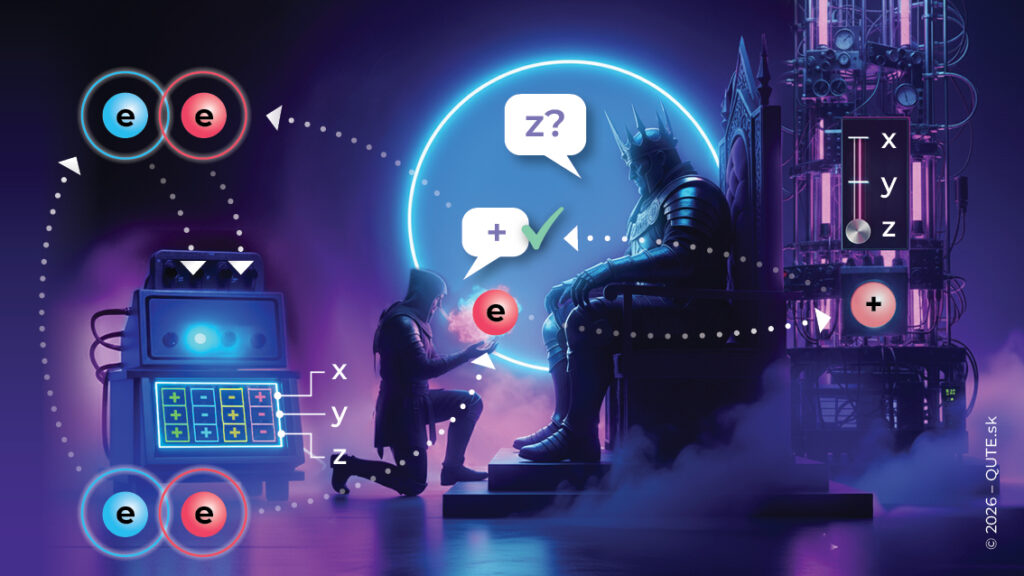
The “Mean King” problem. Using quantum entanglement, the knight is able to accomplish an otherwise impossible task. The outcomes of his measurement (shown in different colours) uniquely determine the hidden result for each of the king’s three possible measurements. In the illustrated case, the king performed a spin measurement along the z-axis with a positive (+) outcome. The knight obtained a blue result and, when questioned by the king, answered correctly.
Specifically, the king demanded that the knight bring him any electron before lunch. The king would then measure the electron’s spin along one of the axes x, y, or z and return the electron to the knight. At dinner, they would meet again, and the king would at least reveal which axis he had chosen. The knight’s task would be to state the measurement outcome obtained by the king. If he guessed incorrectly, he would lose his head. If he survived an entire month, he would receive the king’s daughter in marriage – and half the kingdom.
The knight’s chances of surviving even a single week are slim, since quantum uncertainty fundamentally forbids an electron from having definite values for all three components of its spin. However, because the knight did not ignore entanglement during his quantum studies, he has a way to win the game: the electron he gives to the king is specially quantum-entangled with another electron that he keeps. After the king returns the measured electron, the knight can perform an experiment on both electrons whose outcome uniquely determines the result obtained by the king. It is essential, however, that the king reveal which axis he measured.
It may not seem so, but it is still true that the knight cannot determine all three components of the electron’s spin angular momentum. Each spin component has only two possible values, +1 or −1. The knight’s experiment has four possible outcomes. Each of them provides information about what result the king obtained, provided he measured along the x, y, or z axis. Quantum physics, however, allows the king to measure only one of these components, and therefore only one component actually acquires a definite value. The remaining components – whose values are inferred from the knight’s result – do not exist; they are not real.
Entangled Pseudotelepathy
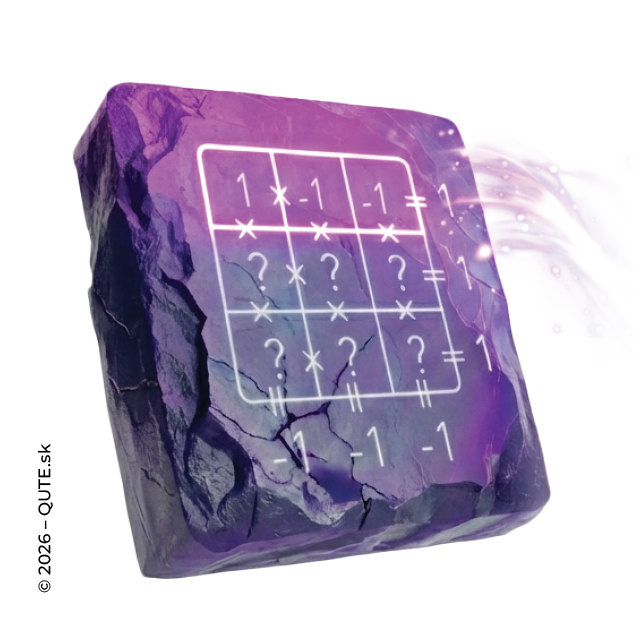
Two captured outlaws, Cyril and Methodius, were given a final chance before the court. They had to agree on the location of a hidden treasure. The treasure could be placed at three locations (the pub, the church, or the university) in three different cities (Trenčín, Zvolen, and Prešov). The result of their agreement is a 3 × 3 table in which we place +1 if the treasure is located at a given position, and −1 if it is not.
Cyril is asked whether the treasure is located at position X in the cities, or not. Methodius is asked whether the treasure is located at any position in city Y, or not. Neither of them knows which question the judge asked the other. If their answers agree on whether the treasure is located at position X in city Y, they win. If their answers disagree, it is the end for them. Without further constraints, Cyril and Methodius would have no trouble winning – for example, they could simply agree that there is no treasure anywhere.
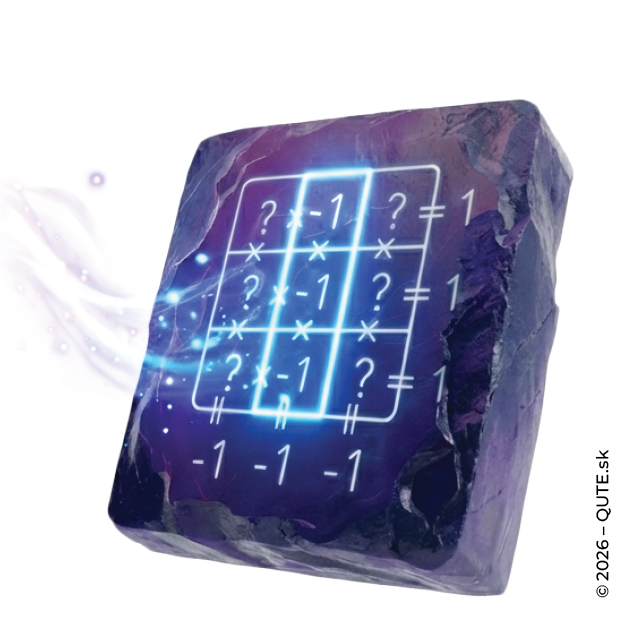
To prevent this, the judge imposes the following restrictions. For each location, Cyril must either place the treasure in exactly one city or distribute it among all three. Methodius must either hide no treasure at all in a given city or place it at exactly two locations. Cyril and Methodius quickly realize that these conditions define a hypothetical magic square whose column products are positive and whose row products are negative. Such an object cannot exist, because the product over columns must be positive, while the product over rows must be negative – yet both products must be equal.
Telepathy would certainly help. Cyril and Methodius therefore share two maximally entangled pairs of qubits. There exists a 3 × 3 table of two-qubit measurements (the so-called Peres–Mermin square) that, when applied to such prepared qubits, reproduces the required properties of the magic square. The measurements in this table are mutually compatible along rows and along columns. Quantum physics guarantees that Cyril and Methodius will always obtain the same result at the intersection of a row and a column, and thus they always win – and that is quantum pseudotelepathy.
Author of the article: Mário Ziman, Institute of Physics, Slovak Academy of Sciences, Bratislava
Illustrations: Diana Cencer Garafová, QUTE.sk – Slovak National Center for Quantum Technologies
Image source: wikipedia public domain