

Beware of the Quantum Sensor
- Home
- Quniverse
- Quantum World
- Beware of the Quantum Sensor
Quantum World
Beware of the Quantum Sensor
Quantum computers and quantum cryptographic systems are not the only goals of quantum technology research and development. In fact, quantum sensors are much closer to widespread deployment. These devices allow us to detect even the tiniest changes and the smallest values of physical parameters in the world around us.
Realizing quantum bits is challenging because of their sensitivity to environmental influences – the quantum noise of their surroundings causes decoherence. As the saying goes, however, every cloud has a silver lining. Paradoxically, this very weakness becomes the greatest strength of quantum sensors. More importantly, the question is no longer whether quantum sensors will exist and work, but rather where they can be most useful.
Modern medicine already relies on a wide range of imaging techniques, from X-ray imaging (X-ray, CT) and magnetic resonance imaging (MRI) to positron emission tomography (PET). At their core, all of these are quantum technologies. The emerging technologies of the second quantum revolution, however, aim to improve them even further. More generally, quantum sensors are expected to measure and map forces and fields with unprecedented precision, allowing us to see literally beneath the surface and deep inside objects – from the human body to the Universe itself.
Inspired by Biology
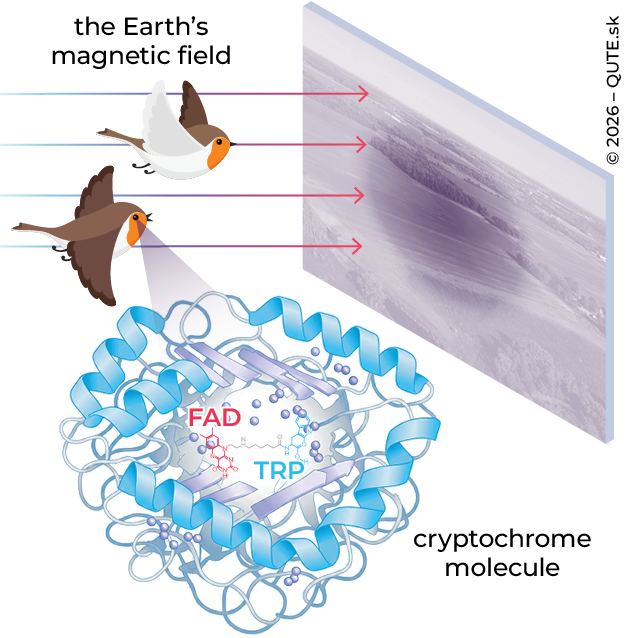
The European robin – a living quantum detector. Molecules of cryptochrome in its retina are sensitive to magnetic fields, influencing the bird’s vision.
For many years, biologists have suspected that migratory birds navigate with the help of their ability to sense the Earth’s magnetic field. Experiments with the European robin (Erithacus rubecula) have shown that the birds lose their sense of direction when placed in artificially generated magnetic fields. Similar disorientation has also been observed under red light, indirectly suggesting that the robin’s magnetic sense is linked to its eyes.
Subsequent studies revealed that the robin’s retina contains a special light-sensitive protein called cryptochrome 4a, which is particularly sensitive to blue light. Interestingly, the concentration of this protein increases during migration periods. As researchers investigated the underlying navigation mechanism in greater detail, they concluded that this remarkable ability is most likely quantum in nature. This hypothesis is further supported by the observed disorientation of robins exposed to radio waves of specific frequencies, suggesting a form of quantum interference.
The Radical Pair Mechanism
When a blue photon is absorbed, two molecular components separate from the cryptochrome: flavin adenine dinucleotide (FAD) and tryptophan (TRP). Together they form what is known as a radical pair, with each molecule containing one unpaired electron. In ordinary chemical compounds, paired electrons differ only in their spin quantum number. Once the radical pair is created, the two molecules separate while the spins of their unpaired electrons remain quantum mechanically entangled.
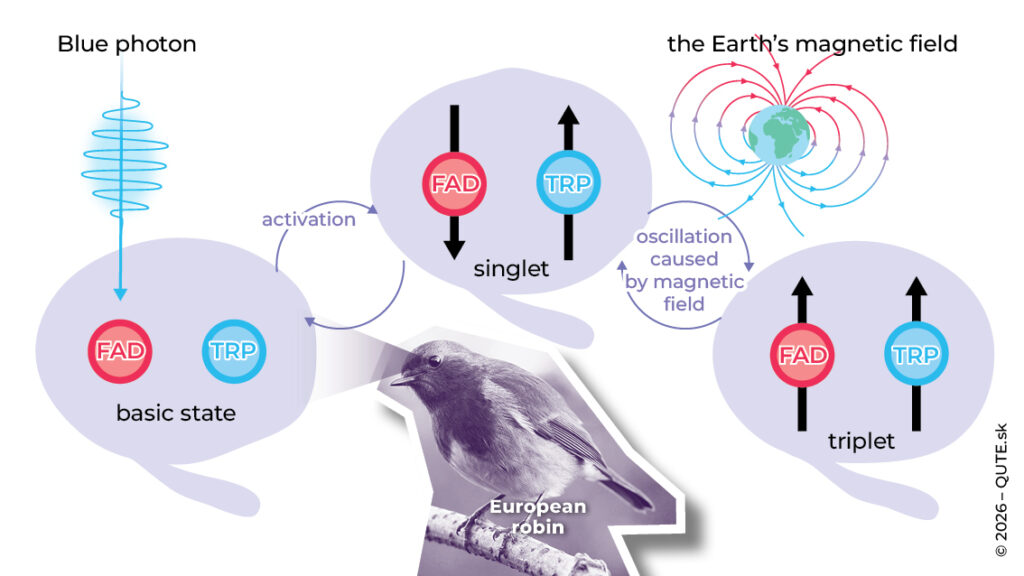
The radical pair mechanism. Absorption of a blue photon creates radicals with quantum-entangled spins whose oscillations depend on the magnetic field.
Spin behaves like a tiny magnet and is fundamentally responsible for the magnetic properties of matter. After photoactivation, the two electron spins begin to oscillate in the magnetic field between a parallel configuration (known as the triplet state) and an antiparallel configuration (the singlet state). The magnetic field determines the character of these oscillations, resulting in different activation times of the cryptochrome molecule. This phenomenon is believed to form the basis of the bird’s magnetic sensing mechanism.
A Vision of Magnetic Vision
The prevailing hypothesis is that the activation of cryptochrome affects the signals transmitted from the retina to the brain for further processing. Although many details of this process remain under investigation, researchers believe that the robin may literally see the Earth’s magnetic field as variations in the brightness or contrast of different regions of its visual field.
If these hypotheses are correct and robins are indeed capable of maintaining stable quantum states under conditions normally considered too noisy for quantum effects to survive, this research could have profound technological implications. The robin’s eye may inspire entirely new approaches to magnetic field sensing and quantum information storage. Nature has often inspired revolutionary technologies, and the quantum robin may become yet another remarkable example.
Quantum Sensors
The operating principle of quantum sensors is conceptually straightforward. We use quantum systems prepared in a state that is maximally sensitive to the environmental parameter we wish to measure. As the system interacts with its surroundings, its quantum state changes. Our task is to detect this change. Since the evolution of the system depends on the value of the environmental parameter, we can infer its value from the observed change.
The more precisely we can measure the quantum system and the better we understand its interaction with the environment, the faster and more accurately we can determine the parameter of interest. An individual quantum measurement, however, provides little information because its outcome is inherently random. Measurements therefore have to be repeated, and the result of a quantum measurement is ultimately expressed as a probability. The uncertainty of the estimated parameter is determined by how accurately this probability can be established. Absolute precision would require an infinite number of measurements and is therefore fundamentally unattainable.
In classical measurements, statistical uncertainty typically decreases proportionally to the square root of the number of repetitions. Quantum measurements, however, can exploit entangled states, making it theoretically possible to achieve a precision that scales linearly with the number of measurements. In principle, one hundred measurements performed with an ideal quantum sensor could provide the same precision as ten thousand measurements with a classical device. Unfortunately, preparing the required entangled states is far from simple.
Quantum sensing is not only about improving statistical precision. Its greatest advantage lies in its enhanced resolution, enabling us to observe phenomena that would otherwise remain invisible. A striking example is the detection of gravitational waves. By employing squeezed states of light, researchers have significantly increased the sensitivity of gravitational-wave detectors, leading to a substantial rise in the number of observed events. Today, the LIGO observatory detects a gravitational-wave signal approximately once every three days, whereas during its early years such events were recorded only about once a month.
Quantum Medicine
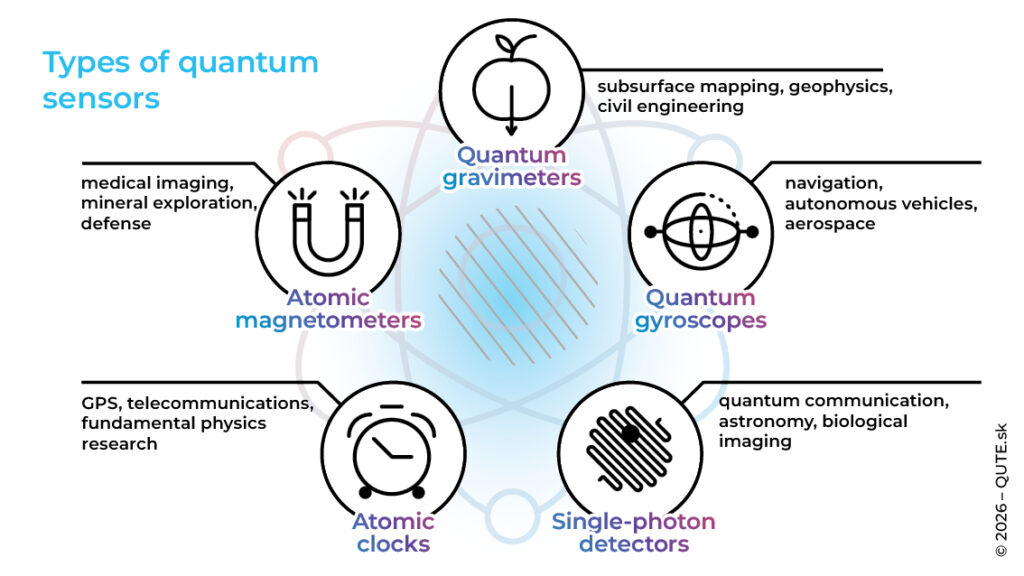
Most of us are familiar with the electrocardiograph (ECG), a common medical device that records the electrical activity of the heart. Measuring magnetic fields, however, can reveal additional information about cardiac function and disease, sometimes even earlier than an ECG. For example, myocardial ischemia cannot always be reliably detected using conventional electrocardiography. Several research groups are therefore developing and testing ultra-sensitive magnetocardiographs (MCGs) based on nitrogen-vacancy (NV) centers in diamond. These are defects in the diamond crystal lattice where two neighboring carbon atoms are replaced by a nitrogen atom and a vacant lattice site.
Another important technology is magnetoencephalography (MEG), which measures the extremely weak magnetic fields generated by neural activity in the brain. Current MEG systems rely on superconducting sensors that must be cooled to cryogenic temperatures and operated inside magnetically shielded rooms, making them expensive and difficult to deploy. Quantum magnetometers based on optically pumped atoms or NV centers operate at room temperature, offering a promising alternative. Several start-ups are already developing wearable MEG systems, which could enable earlier diagnosis of neurological disorders, improved functional brain mapping before surgery, and real-time monitoring of conditions such as epilepsy.
Quantum Navigators and Prospectors
Navigation based on satellite systems has become an everyday standard and works almost everywhere. However, it is vulnerable to signal loss, whether due to natural obstacles such as tunnels or deliberate signal jamming. Quantum gyroscopes and quantum accelerometers based on atom interferometry offer a fully functional alternative. By directly and ultra-precisely measuring acceleration and rotation, they enable vehicles to determine their position without relying on any external communication. In March this year, such a quantum navigation system was successfully tested on a fully operational railway network in the United Kingdom.
Another exciting field of application is subsurface exploration. Everything hidden underground should beware. Quantum gravimeters can map underground structures, detect hidden tunnels, damaged pipelines, and buried objects without the need for invasive excavation. The first generation of quantum prospectors is already here.
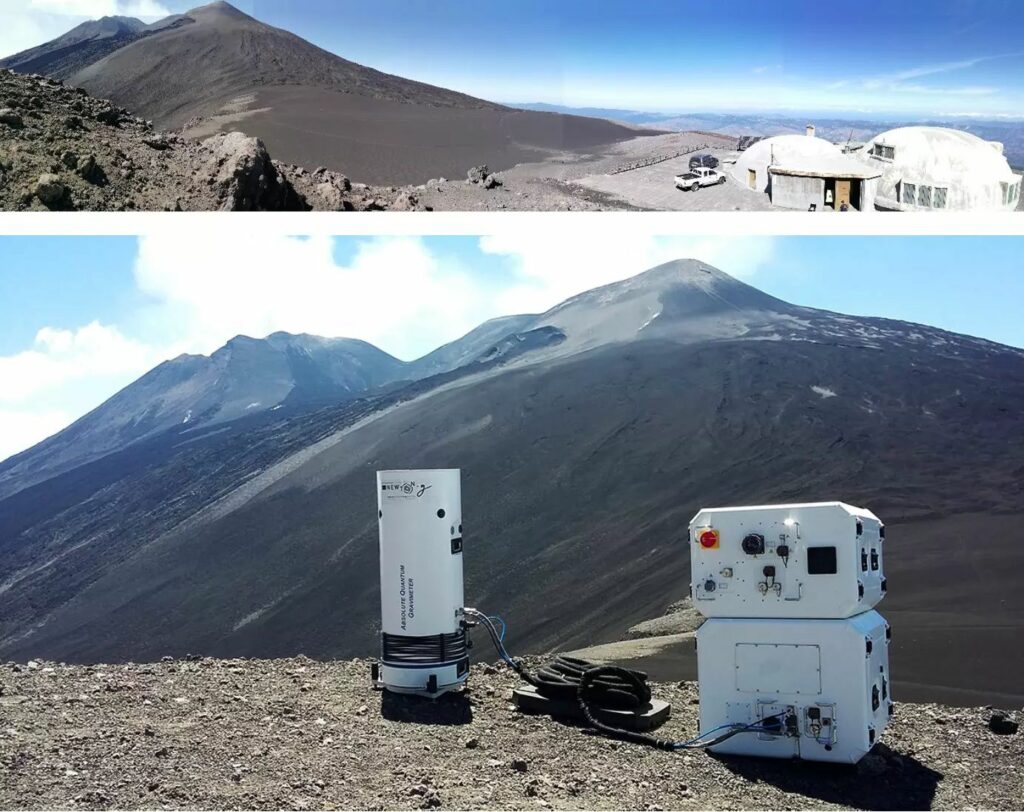
Quantum gravimeter developed by Exail during field measurements on Mount Etna (2020). Source: Exail, DOI: https://doi.org/10.1029/2022GL097814
Author of the article: Mário Ziman, Institute of Physics, Slovak Academy of Sciences, Bratislava
Illustrations: Diana Cencer Garafová, QUTE.sk – Slovak National Center for Quantum Technologies
Image source: wikipedia public domain, Exail