


Quantum World
Magica Quantica Polarica
The year was 1001. Heavy snow was falling, and the crew of a drakkar hesitated about how to proceed. The Viking king had a sunstone brought to him and determined the direction of the voyage. Without knowing it, he made use of a hidden world of light – polarization.
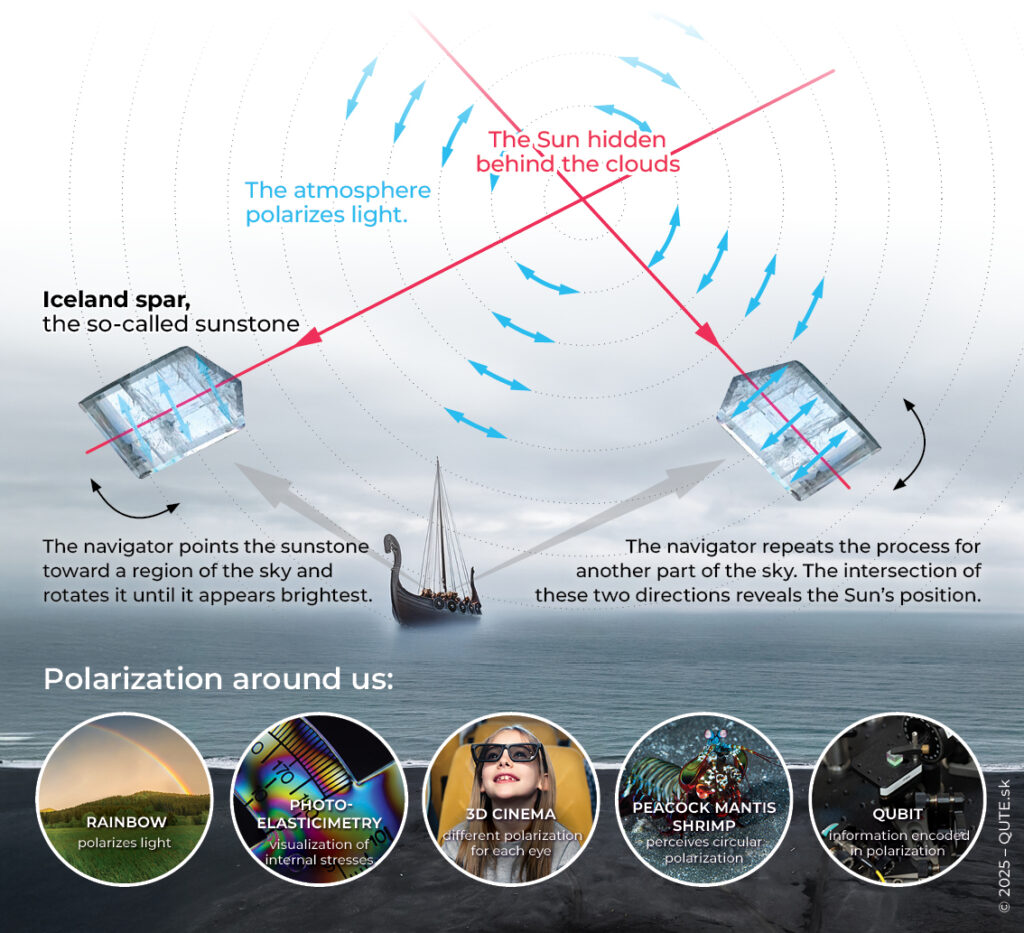
So far, no direct evidence has been found that Vikings actually used sunstones for navigation. They certainly did, however, contribute to the discovery of Iceland, where Iceland spar occurs – a crystal that enabled us to discover the world of light polarization. The story began in 1669 in Copenhagen, when Erasmus Bartholinus was the first to describe double refraction (birefringence) in Iceland spar, a phenomenon in which an incoming light ray splits into two. Birefringence puzzled both Isaac Newton and Christiaan Huygens, each of whom explained it in his own way. Yet neither of them truly spoke about different polarizations of light.
Magica polarica
In 1808, the French physicist Étienne-Louis Malus noticed that when viewing the light reflected from the windows of the Luxembourg Palace in Paris through a crystal of Iceland spar, its intensity changed depending on the crystal’s orientation. Through experimentation, Malus concluded that reflected light (from various surfaces) can be internally ordered along a particular direction – means polarized. He imagined light particles as tiny magnets that align themselves in a certain direction upon reflection. He introduced the concept of light polarization and formulated Malus’s law, which relates the intensities of incident and transmitted light as a function of their relative polarization.
Today, in the context of Malus’s law, we use polarizing filters (polarizers) instead of Iceland spar, and we describe light as electromagnetic waves. Within this framework, polarization expresses the manner in which the electromagnetic field oscillates; it always oscillates in a plane perpendicular to the direction of propagation. If it oscillates up and down along a specific direction, we speak of linearly polarized light. We distinguish, for example, horizontal polarization (H), where the oscillation is parallel to the horizon. If the oscillation is perpendicular to the horizon, we speak of vertical polarization (V). Oscillation exactly midway between horizontal and vertical is referred to as diagonal polarization (D), and polarization perpendicular to it is called anti-diagonal (A).
Cosinus quadratus
Malus’s law tells us that by rotating two polarizers relative to each other, we can control the intensity of the transmitted light. Light passing through a polarizer does not change its frequency or direction of propagation, but its polarization acquires the orientation of the polarizer. The polarizer “reshapes” the transmitted light in its own image, regardless of the light’s original polarization. The intensity of the light transmitted through a polarizer depends on the square of the cosine of the angle between the original polarization and the orientation of the polarizer. The closer this angle approaches a right angle, the less light passes through. When two polarizers are oriented perpendicular to each other, the transmission of light is completely suppressed.
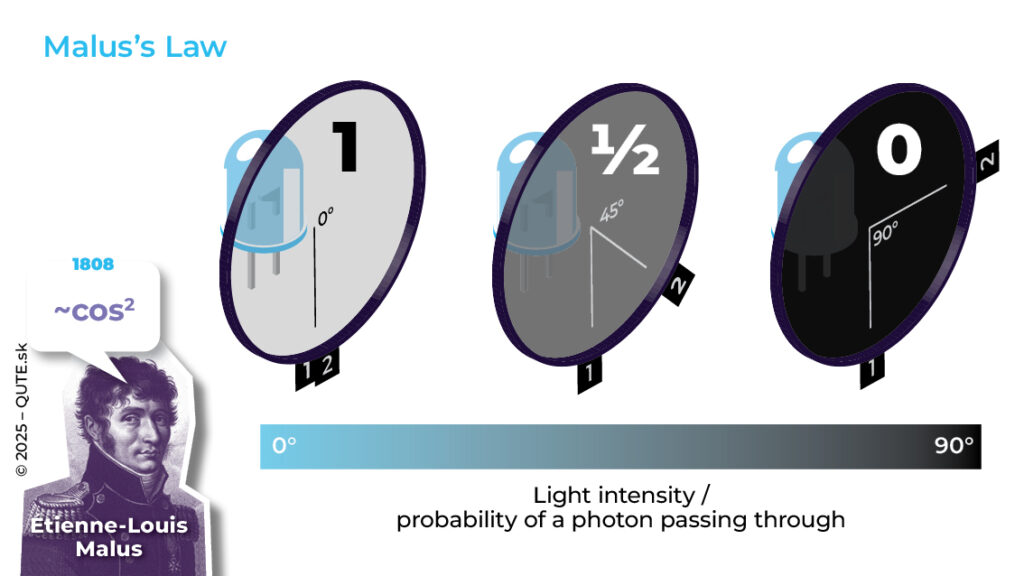
In the context of the wave description of light, Malus’s law allows us to calculate light intensities after passing through polarizers. Here, however, we are interested in polarization in the context of quantum physics, that is, at the level of individual photons.
Polarica photonica
A photon, the smallest possible quantum of light energy, carries with it electromagnetic interaction. Through photons, light acts on electrically charged particles, which respond to light as a force that sets them into motion and oscillation depending on the photon’s polarization. A polarizing filter is a relatively thin film composed of long polymer molecules arranged in parallel lines. These polymers restrict the motion of electrons to the direction along the molecule. If a photon incident on the filter is polarized along this direction, its electric field sets the electrons in the polymer into motion, and the photon is absorbed. If, however, the polarization is perpendicular, the electrons do not oscillate and the photon passes through unobstructed.
What happens if the photon’s polarization is, for example, diagonal? Malus’s law tells us that half of the photon’s energy passes through while the other half is absorbed. But a photon is the smallest possible quantum of energy and therefore cannot pass through “halfway.” It could, in principle, split into two photons with half the energy, but that would imply a change in frequency and color – something we do not observe. What, then, actually happens to the photon?
Transitus probabilitae
The answer given by quantum physics is that this is a random process, whose outcome cannot be predicted, only assigned a probability – that is, the probability that the photon will pass through the polarizer. This probability is compatible with Malus’s law, which we understand as a statistical manifestation of the quantum properties of individual photons that make up light. Light intensity expresses the energy carried by light. It is the sum of the energies of individual photons, each carrying energy according to Planck’s relation E=hf, where h is Planck’s constant and f is the photon frequency. In the case of diagonally polarized photons, each photon has a 50% chance of passing through the polarizer. On average, therefore, half of the photons pass through, and the light intensity is reduced by half – exactly in accordance with Malus’s law. While in optics Malus’s law describes the reduction of beam intensity, at the level of a single photon it expresses the probability of transmission through a polarizer.
Photonica cryptica
Photon polarization is a canonical example of the simplest quantum system – the quantum bit (qubit). Logical values zero and one are encoded into mutually orthogonal polarizations, for example horizontal and vertical polarization. Mutually orthogonal pairs of polarizations are called bases. A vertically oriented polarizer is a device that evaluates logical values encoded in individual photons in the H–V basis. A horizontally polarized photon will never pass through such a polarizer and yields the value 0, whereas a vertically polarized photon always passes through with certainty, yielding the value 1. For a photon with any other polarization, no definite logical value can be assigned, and we speak of a superposition of values. If we attempt to determine it, the result will be random.
The “holy grail” of cryptography is the creation of a system that securely generates identical randomness at two distant locations – a cryptographic key that enables mathematically secure information transfer. Creating such a key is, however, a challenging problem. The randomness associated with superposition and the quantum uncertainty of photon polarization offers a relatively simple solution. The first Quantum Key Distribution (QKD) protocol was introduced in 1984 by Charles Bennett and Gilles Brassard. This protocol is known as BB84, and today there are commercially available devices that secure communication in this way.
Clavis quantica
In BB84, the communicating parties generate a shared cryptographic key –a sequence of zeros and ones – which they subsequently use to securely encrypt messages. The bit values of this key are represented by photon polarizations H, V, D, and A – two bases rotated by 45° with respect to each other. If a photon is measured in a basis different from the one in which it was prepared, its state changes and the measurement result is random. This allows any eavesdropping attempts to be detected. If an eavesdropper tries to intercept the transmitted photons and measure their polarization, measuring in the wrong basis alters the photon’s polarization. The communicating parties will subsequently notice these changes.
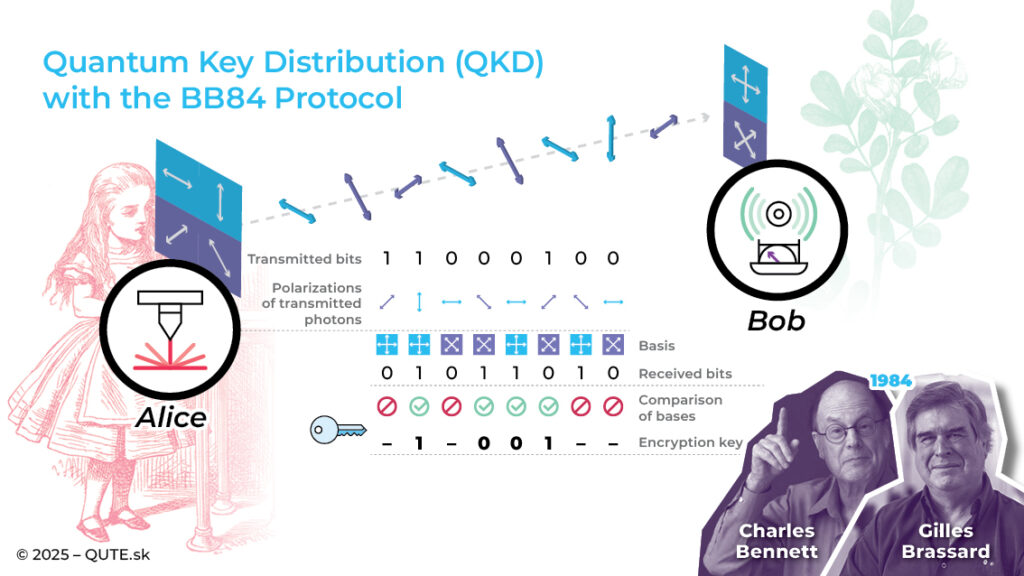
Quantum cryptography enables the generation of cryptographic keys whose security is based on the validity of quantum principles, rather than on high computational complexity, which underpins the security of contemporary cryptography. For this reason, the importance of quantum-secured communication is increasing alongside the development of quantum computers. Slovakia is an active participant in the European EuroQCI initiative, whose goal is to establish a backbone quantum-secured communication network across Europe.
Author of the article: Mário Ziman, Institute of Physics, Slovak Academy of Sciences, Bratislava, Alexandra Butašová, student of Gymnasium Metodova, Bratislava
Illustrations: Diana Cencer Garafová, QUTE.sk – Slovak National Center for Quantum Technologies
Image source: wikipedia public domain, www.nobelprize.org