

QUANTUM WORLD
The Dance of Light and Matter
When looking through a transparent material, under certain conditions, two images merge. We see what is outside the glass, while simultaneously perceiving light reflected from the inside. What is happening at the level of photons and atoms?
Most of us have experienced that when light hits a material, three phenomena occur: part of the light is absorbed, part passes through, and part is reflected. Each of these portions can be zero and depends on the frequency of the light. Thanks to quantum physics, we can explain the properties of the materials around us as well as their interactions with light. When a photon strikes a molecule or an atom, no kind of mechanical collision occurs in which the photon simply bounces off the surface of the molecules. Instead, the photon carries a potential quantum of energy, and at the quantum level, the quantum waves of light photons and matter particles meet. They begin a shared dance described by the Schrödinger equation. The outcome may be that the photon is absorbed, reflected, or passes by the atom unnoticed. Especially if it’s not the right one “for the dance.”
The Cycle of Photons
The quantum wave of a photon’s life doesn’t end with its absorption. Without going into detail, the electromagnetic field actively exists even when it contains no photons. From the perspective of quantum physics, there is no fundamental difference between describing the state of light that contains zero photons or one hundred photons. In both cases, we speak of a photon quantum wave, which is, even without photons, always present and ready for their creation.
When a photon is absorbed, it transfers its energy to the particles of matter. Sometimes it may give them more than they need, and they might not “like” it. They get rid of the excess energy, and the result is the emission of one or more photons. This process is known as spontaneous emission. The emitted photons may have a different frequency than the original one, but more often they have the same. In addition to energy, the particles of matter also gain momentum and polarization from the photon. The emitted photon can reflect these properties to varying degrees, which appear as characteristics of the material. The direction of the emitted photon is related to whether we refer to it as the reflected photon or as the one that has passed through.

Spontaneous and stimulated emission
Probability of Independent Behavior
In optical experiments, we often use semi-transparent pieces of material, and we call these devices beam splitters. From the photon’s perspective, we can imagine an ideal beam splitter as a wall with a door exactly at the point of incidence, which either opens and allows the photon to pass through undisturbed, or remains closed and reflects the photon. Imagine a situation where two photons arrive at this door simultaneously, each from the opposite side. If the door opens, it is natural to imagine that they collide like two billiard balls. The result would be that both photons stay on their original sides of the door and continue onward, as if the door hadn’t opened.
However, we don´t have reason to assume that the opening of the imaginary door doesn´t happen individually for each photon. In other words, it could work such that the door opens for one photon while remaining closed for the other – even though both arrive at the same door simultaneously. With this idea of independent photon behavior, four situations can occur: both photons end up on the left side, both photons end up on the right side, the photons exchange sides, or the photons remain on their respective sides. If we assume that each photon individually has an equal chance to either pass through or be reflected, then each of these possibilities is equally probable.
The Mystery of the Beam Splitter
In 1987, Chung Ki Hong, Zheyu Jeff Ou, and Leonard Mandel performed an experiment with two photons and a beam splitter. They observed that two out of the four possible outcomes never occurred. Both photons always ended up together on the same side of the beam splitter. They recorded only the cases when detectors on the left and right sides detected a photon simultaneously. They studied how the coincidence of photon detection depended on how precisely the two photons overlapped at the beam splitter. The coincidence rate dropped to zero at the point of perfect overlap, creating what is known as the Hong-Ou-Mandel dip (HOM).
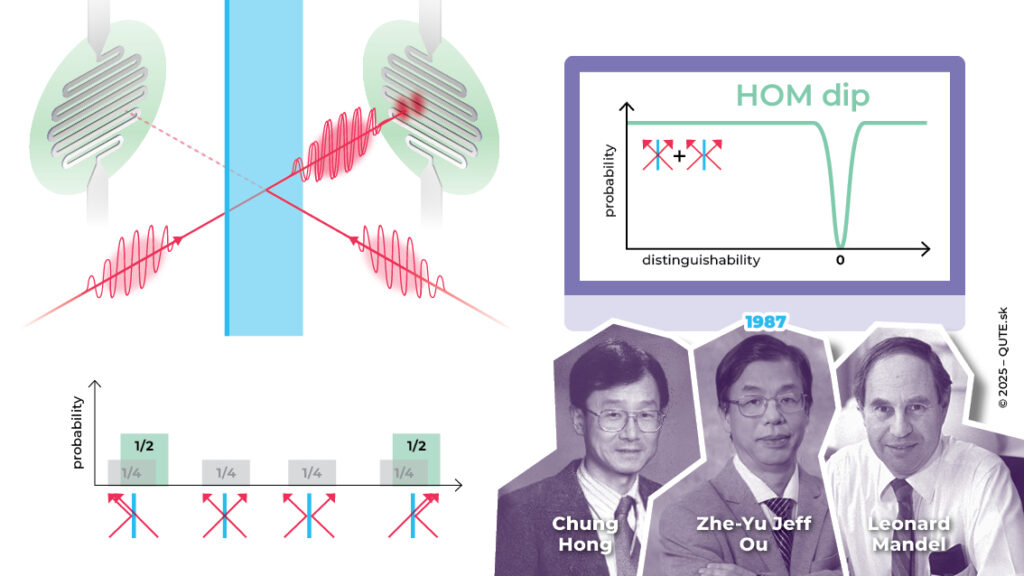
In the graph, the left side of the figure shows the probability of two photons meeting at the beam splitter for distinguishable photons (gray) and indistinguishable photons (green). On the right side of the figure, the probability of both detectors clicking as a function of the overlap (distinguishability) of the photons at the beam splitter. In the case of perfect timing, the probability drops to zero.
The explanation of HOM lies in the indistinguishability of photons that are perfectly timed at the beam splitter. From the traces left on a photographic plate or a CCD camera, we cannot tell which record corresponds to which photon. Quantum uncertainty prevents us from identifying the trajectories of their motion. Moreover, quantum indistinguishability adds interference of their identities, causing the possibilities of the photons ending up separately in the right and left detectors to cancel each other out through interference. The quantum description of the two-photon system ensures that they cannot be individually named, because they cannot maintain their identity. They behave as a single entity — a two-photon system. And this applies not only to the outcome but throughout their entire existence. HOM’s sensitivity to photon identity has applications in ultra-precise measurements and is part of the implementation of logical operations for photonic quantum computers.
Light Amplifier Stimulated by Radiation
In HOM, we observe a tendency of identical photons to stay together and behave in the same way. This property is crucial for the operation of a laser. Any light source we have works on the principle that matter, composed of atoms, releases excess energy in the form of photons. In the case of an incandescent lamp, an electric current passing through heats the atoms of the tungsten filament, which releases this energy through spontaneous emission in the form of infrared, visible, and ultraviolet photons. The ultraviolet photons are blocked by the glass envelope of the lamp, and the infrared photons are perceived as emitted heat. Spontaneous emission produces individual photons at random times and in random directions. Their polarization and energy are internally related to the properties of the atoms, but ultimately, the emitted photons have random properties and characteristics.
A laser uses the phenomenon of stimulated emission to produce photons. There are situations in which a photon could be emitted spontaneously, but it is not. These correspond to the so-called metastable states of atoms, in which photons seem pre-prepared, waiting for a small trigger to be emitted. When this trigger arrives, the process of stimulated emission occurs. In the case of a laser, this stimulation is provided by the presence of a correctly tuned photon (radiation), which isn’t absorbed, but whose presence motivates the metastable atom to emit the same photon. At this moment, the emitted photon takes on the characteristics of the stimulating photon, and they become indistinguishable.
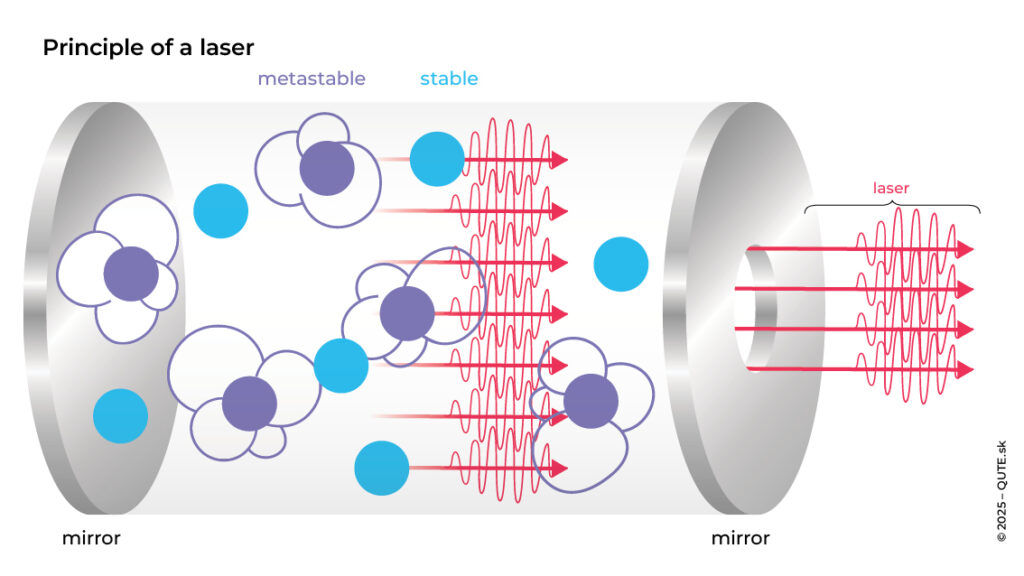
The principle of a laser metastable, stable, mirror, lase
The Path to the Laser
The active medium of a laser is composed of many atoms that are repeatedly excited into a metastable state. When placed between two mirrors, both the stimulating and the stimulated photons keep traveling back and forth among the atoms, triggering more and more atoms to emit identical photons. This leads to an avalanche production of mutually indistinguishable photons, and by releasing them, we create the laser beam as we know it. The laser is one of the most important technologies based on quantum physics. Its history began in 1917, when Albert Einstein laid the foundations of the theory of spontaneous and stimulated emission. Another key breakthrough was the invention of optical pumping, a method that can drive a system into a metastable state. In 1952, Joseph Weber and Nikolaj Gennadijevič Basov together with Alexander Michajlovičom Prochorov independently developed the idea of a microwave source – the maser. Six years later, Charles Hard Townes together with Arthur Leonard Schawlow theoretically described the operation of infrared and optical masers. The term laser was introduced by Richard Gordon Gould, who identified its application potential in optical telecommunications, spectroscopy, interferometry, and nuclear fusion. He spent 28 years in court defending his rejected 1959 patent application for laser construction. The first working laser was built by Theodore Harold Maiman using a ruby crystal, and its red beam was produced for the first time on May 16, 1960.
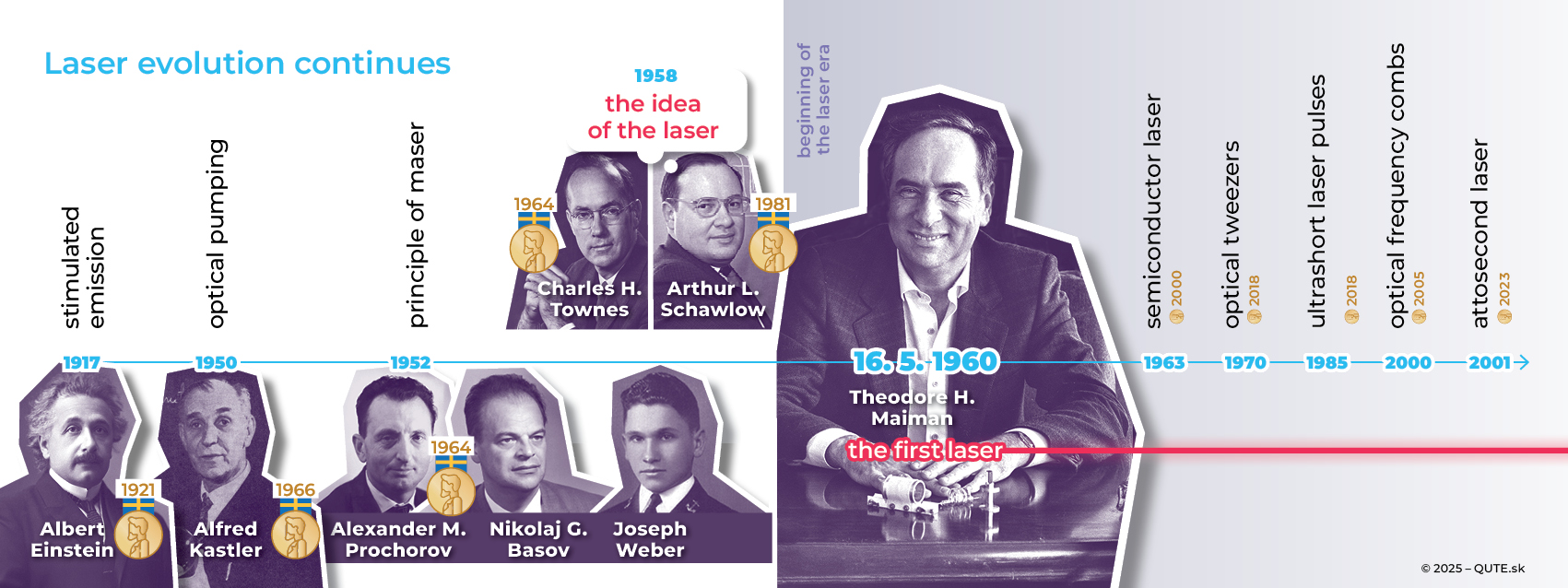
The evolution of the laser continues, stimulated emission, optical pumping, principle of maser, the idea of the laser, beginning of the laser era, the first laser, semiconductor laser, optical tweezers, ultrashort laser pulses, optical frequency combs, attosecond laser
Author of the article: Mário Ziman, Institute of Physics, Slovak Academy of Sciences, Bratislava
Illustrations: Diana Cencer Garafová, QUTE.sk – Slovak National Center for Quantum Technologies
Translation: Gabriela Kotúčová
Image source: www.wikipedia, www-ph.postech.ac.kr, www.pshk.org.hk, nap.nationalacademies.org.